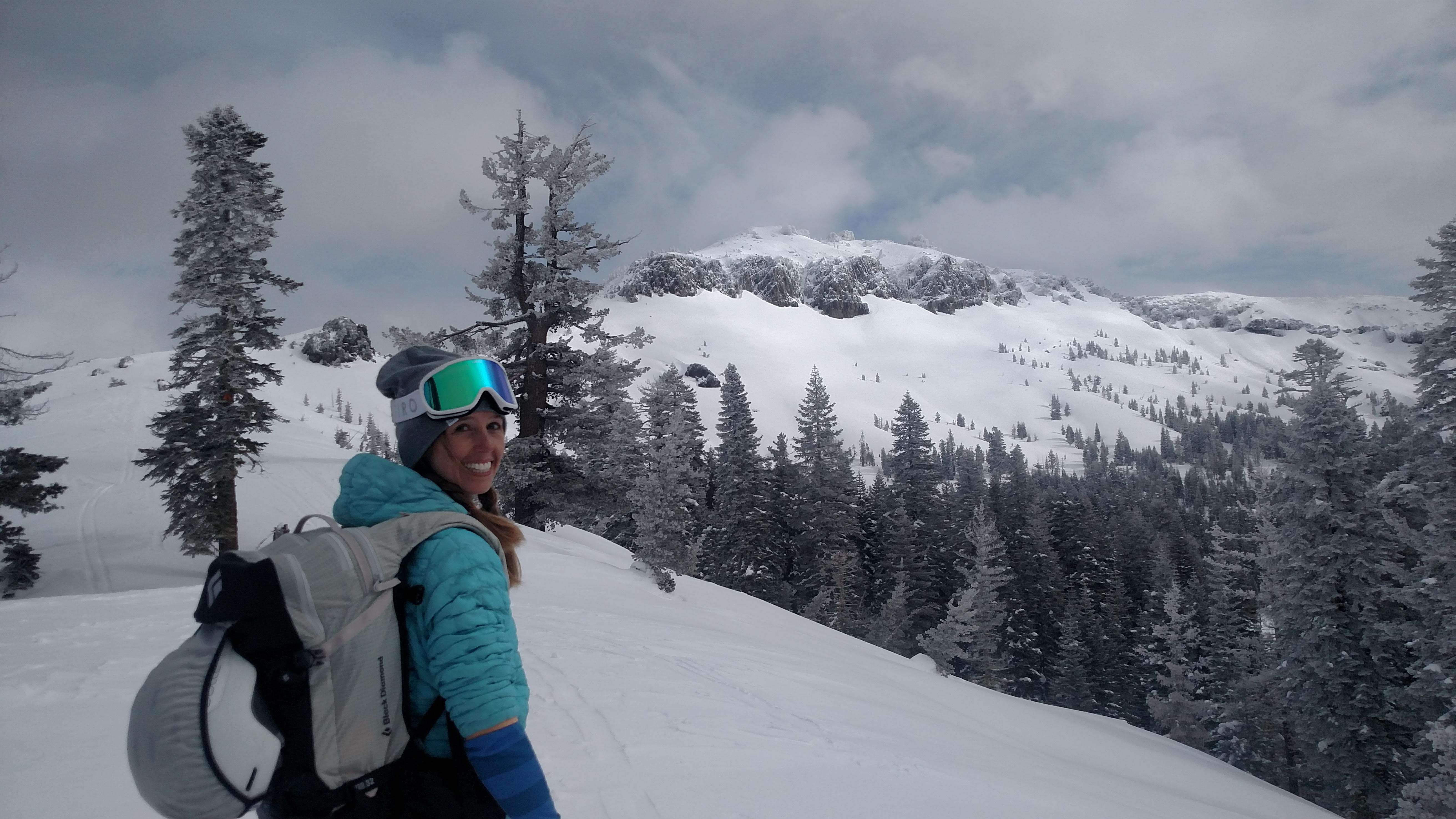

Date: February 24, 2019
Crew: Diana Anthony, Hannah Neville, Grant Oakley
Location: Castle Peak, Donner Summit, CA
“Well definitely don’t come this way!”
Introduction
This post contains fewer pictures and more writing than usual because it covers an avalanche incident that caught a skier (me). For a few more details on the slide itself, you can read my SAC observation submission here. I hope that writing up the full narrative will help me reflect on some of my mistakes, as well as give others some insight into the decision making process.
Plan and Approach
The crew stayed in Soda Springs Saturday night after a day of skiing at Squaw Valley, so we decided that we would wake up Sunday and try the very nearby Castle Peak North Gullies. With Dillon and Kevin both resting injuries, the regular backcountry wolf pack had shrunk to three.
At the time of our planning Saturday night, the avalanche forecast showed “Low” at all elevations and aspects. There was no fresh snow, and the weather was mild and overcast. We planned to start at the Donner Summit Sno-Park trailhead, gain Andesite Ridge via the trail to Grubb Hut, traverse over Castle Peak to the gullies, ski laps, exit to the south, and then get picked up at the I-80 rest stop. We established that we would be skiing in avalanche terrain in the gullies, but that current conditions would allow this. Our plan was assess local conditions on the ridge, and ski milder terrain on south aspects if there were signs of instability or if a cornice had formed over the gullies.
The next morning, Dillon dropped us off at Donner summit. A couple minutes up the trail, Diana remembered that we’d forgotten to re-check the avalanche forecast that morning. The updated weather forecast showed that the SW wind was expected to be strong that day, and the avalanche forecast had been elevated to Moderate for NW-N-NE-E elevations above the treeline due to wind slab problems. This was at odds with our current plan to ski the North Gullies, but we decided to proceed with caution. From our location on the valley floor, there was not even a whisper of wind, and certainly no signs of instability.
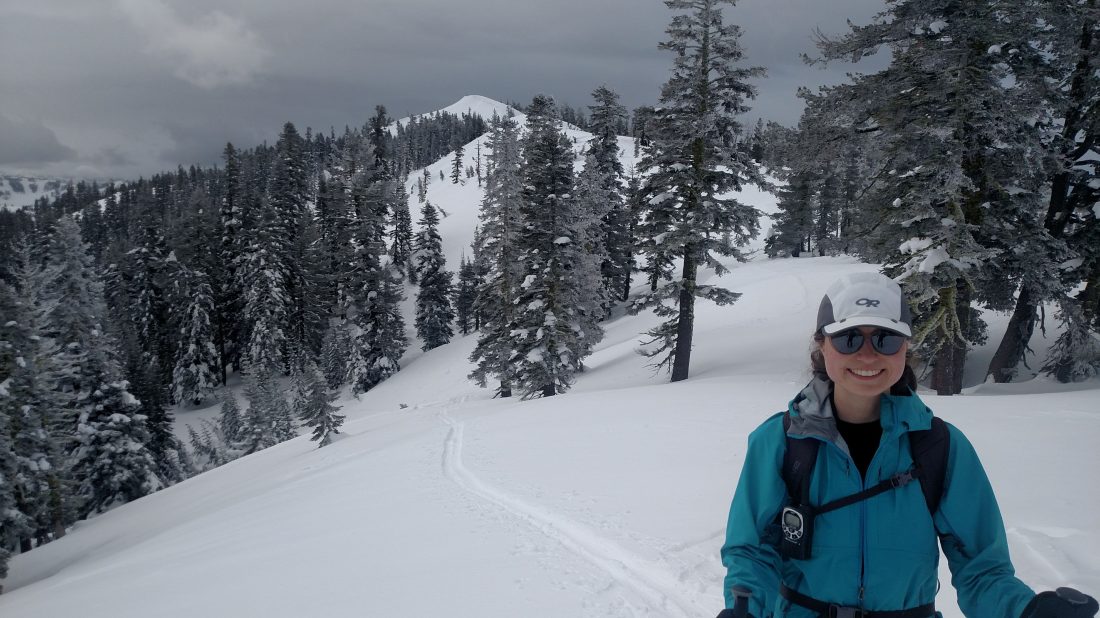
The skin track was well beaten in and we got off to a quick start. We reached the top of Andesite Ridge in about an hour.
Re-evaluating
The wind had definitely started to pick up, and was gradually increasing as we gained elevation up the west flank of Castle Peak. By 8,500′ (near the treeline), the wind had become intense and unpleasant. It was here that we also observed our first sign of snow instability. We began to cross small patches of recent wind deposits, which broke away from the icy layer below in dinner plate sized chunks. We continued for another couple of minutes before deciding that these signs of instability were enough to scratch our objective for the day.
We found a little shelter from the wind behind some trees and transitioned to ski down. We were going to ski the lower angle NW face through the trees to a meadow below. The treed area would be sheltered from the wind and was below 30 degrees. To reach it, though, one had to either re-trace the skin track skier’s left, or ski a 200′ steeper open pitch to skier’s right. We discussed that we ski one at at time until we reached the trees, but never discussed the route we’d take to get there.
I skied first. Knowing full well how icy the skin track was to skier’s left (I’d nearly slid out a couple of times reaching our transition spot), I opted to ski further skier’s right. The slope here was steeper (definitely above 30 degrees), but seemed protected from the wind loading conditions we’d seen on the way up.
Incident
Two turns in, I realized that this was an incorrect assumption. There was plenty of fresh, slabby snow that had recently been deposited on this pitch. I came to a stop and began to slowly traverse off this localized feature as gently as possible. A couple seconds later my feet slipped out from under me. I sat on my hip a little confused as to how I lost my balance, since nothing yet seemed out of place in the flat light. But a split second later, the slab (which had broken in a smooth sheet a foot above me and which I was now riding) disintegrated into blocks and began flowing around me. Before I really had time to figure out what was going on, I instinctively popped back onto my feet skied out the side of the slide.
All-in-all, I’d probably been carried about 15-20 feet down the hill before I was able to stand and ski out. The avalanche broke a foot deep, was about 20 feet wide, and ran about 100 feet. It was not carrying enough snow to fully bury a skier, but it was certainly plenty big to carry someone into a terrain trap or off a cliff, if such feature were below.
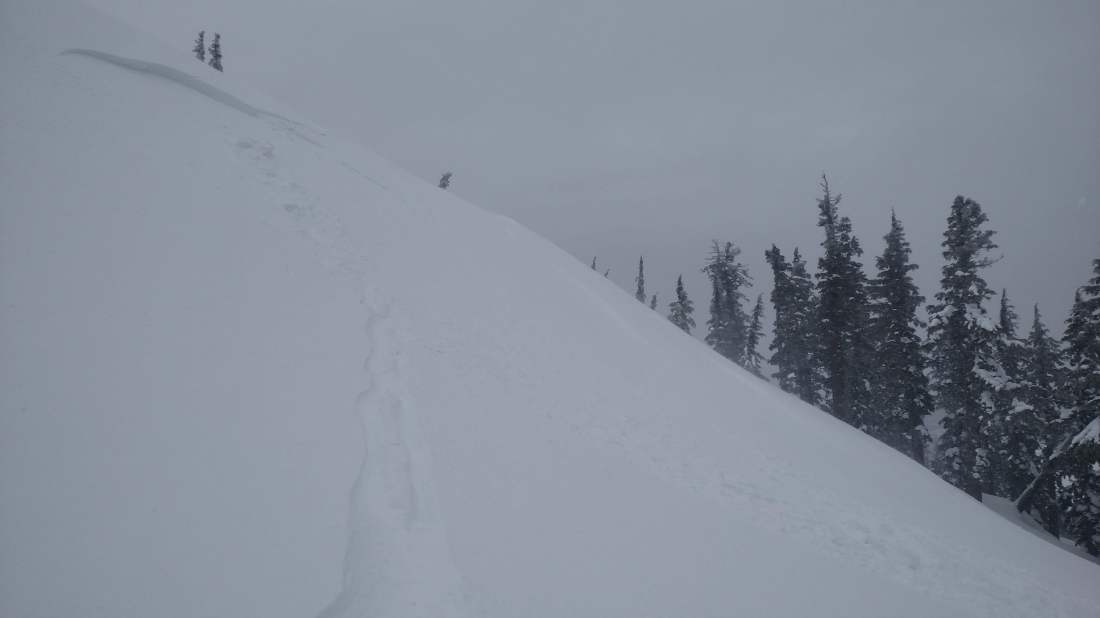
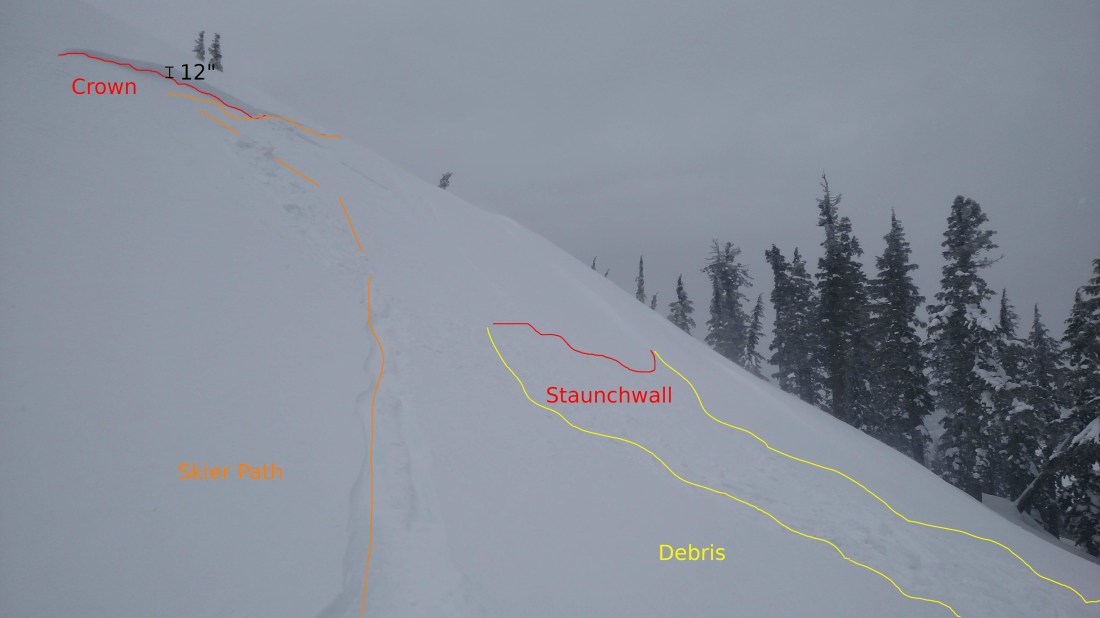
I shakily exited the steep feature to the side of the slope and was checking myself over when Hannah radioed down to ask if I’d reached the bottom. I realized that I was no longer within sight of my partners, and radioed back that they should avoid my route.
Exit
Hannah and Diana followed the skin track one at a time, which was free of wind slabs but proved difficult to navigate due to ice. Eventually, we all regrouped in the trees and had an easy, safe run in a couple inches of fresh snow down to the meadow. From there, we regained Andesite Ridge from the north before getting a few more turns down its south aspect. From there it was easy double poling to the car.
Takeaways
There were a few mistakes that led to the decision to ski an unsafe slope. I think the most critical were:
- Using the previous day’s forecast and not re-evaluating last night’s plans before starting out, even though it “felt” like nothing had changed. With the new weather and snow information, we likely would have chosen a different objective for the day. But an object in motion tends to stay in motion, and once we were already geared up and hiking, the likelihood of us getting back in the car to ski a different area diminished significantly.
- Not respecting snow transport distance. When I began my run onto the problem pitch, I was standing on old hardpack. It seemed to me we had reached the end of the wind desposits off the ridgeline, so anything further from the ridge should be clear of fresh snow. In reality, the loading was variable and highly local, and the steeper pitch had been subjected to plenty of loading due to its particular topography.
- Rushing to escape weather. Standing around in the wind and waiting to start skiing after transitioning, I became very cold. I was antsy to get moving. This probably kept me from taking time to look for warning signs.
- Rushing to reach safer ground. The allure of the very nearby wind-sheltered, low-angle trees caused me to write off the terrain I’d have to cross to reach them.
Wrapping Up
I’m grateful that this mistake only resulted in a short moment of terror and retrospective blog post. The fact that we got some things right (skiing one at a time, recognizing instability and turning around before reaching cliffy terrain, bringing radios) likely prevented the situation from escalating.
I came away from the day with a little better eye for dangerous terrain, and a whole lot more respect for it.
 Grant's Loose Parts Bin